
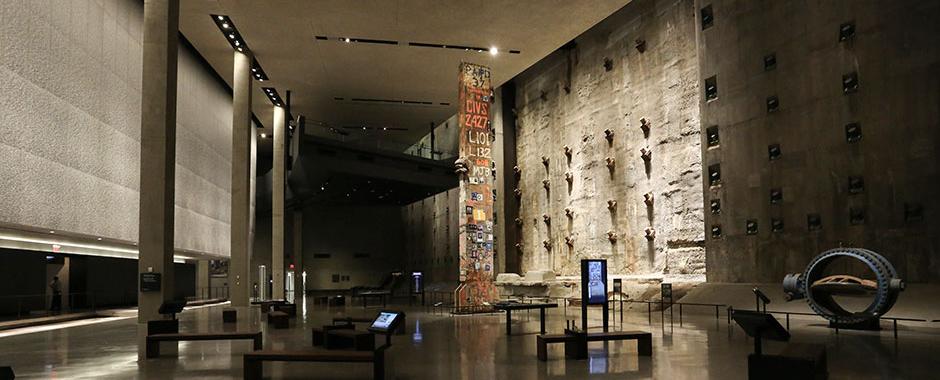
The 9/11 Memorial Museum serves as the country's principal institution concerned with exploring the implications of the events of 9/11, documenting the impact of those events and exploring 9/11's continuing significance. To view Duda Penteado's work at the museum, click here.
9/11 Memorial Museum, NYC
Duda Penteado Revisits a Barrio of the Global Village on the Tenth Anniversary of 11 September 2001
Duda Penteado has been well positioned to explain 911 from a Brazilian-American perspective. On September 11, 2001, Duda was living in Jersey City only a short distance from the World Trade Center. On any given sunny September day, the rays of the morning sun would cast its long shadows onto the waters of the Hudson River that separates New York City from Jersey City. His sister Cristina was living with her husband Mateus in the apartment buildings at the Battery Park City in the shade of the towers. As the sun moves through its daily course, in the afternoon one sees its afternoon shadows cast by the glass and steel residential towers of Battery Park City. And so Penteado saw before his eyes, the columns of smoke and ash rising on the day of the attack and then settling in the ensuing days of uncertainty.
As the towers burned Penteado was unable to make telephone contact with Cristina or Mateus. Finally, two days after the towers had collapsed, it was Duda’s mother who called from São Paulo to tell him that his sister and brother in law were safe.
The fact that a terrorist attack could succeed in New York City at the heart of world finance was a convincing reminder that the New York City is just another barrio in the global village under threat of terrorism.
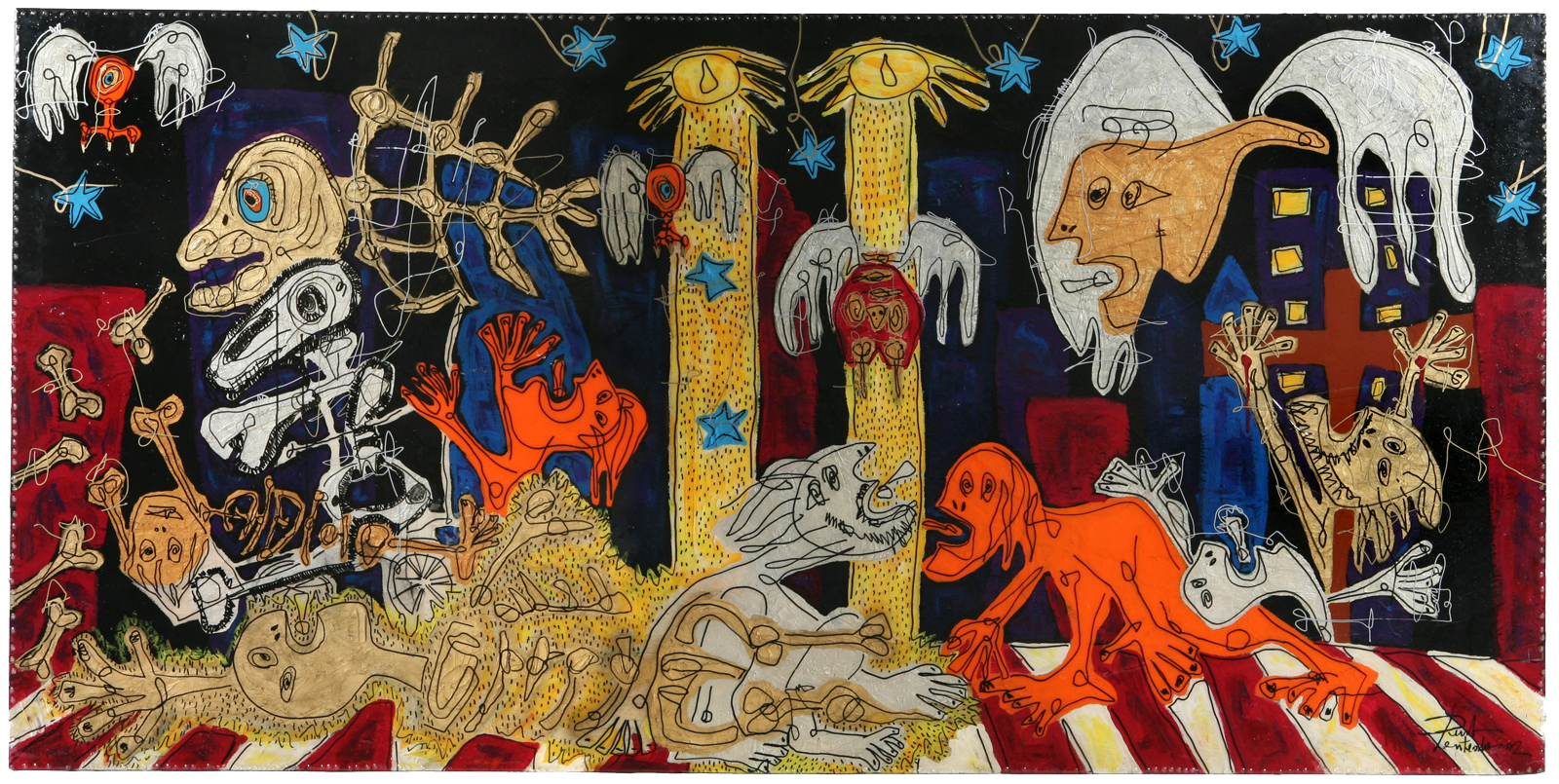
Duda Penteado has personally marked each anniversary of the attack with an ongoing production of thematically related works of art. These works rely on visual devices and literary clues from the compositional plan and iconography of Pablo Picasso’s Guernica as a grid on which to build his own compositions. Guernica was chosen because it is so widely assumed that the village was the first populated area to fall victim to ‘strategic bombing’ in modern times.
But in fact, two decades earlier the French, Germans and their allies had already used ‘strategic bombing’ on the cities of their European enemies in the First World War: “The War to End All Wars.” The massive bombing of Nanking and other Chinese cities by the Japanese in WW II, and the subsequent ‘strategic bombing’ of London and Coventry were followed by retaliation in kind by the Anglo-American forces and their allies on Axis cities. All of this culminated in the fire-bombing of Tokyo in early 1945 and the ensuing immolation of Hiroshima and Nagasaki. The theoretical rationale for ‘strategic bombing’ is that it breaks the will of a populace to support its own government’s ability to wage war. We can respond with certainty with two answers to this theory. Terrorism, be it against an external enemy or internal rebellion has rarely succeeded and when it has, it is historically known that the success was temporary. In spite of the term terrorism having been born in historically recent times – during the French Revolution, terrorism is as old as human conflict. It is just that the means of spreading it have improved and escalated.
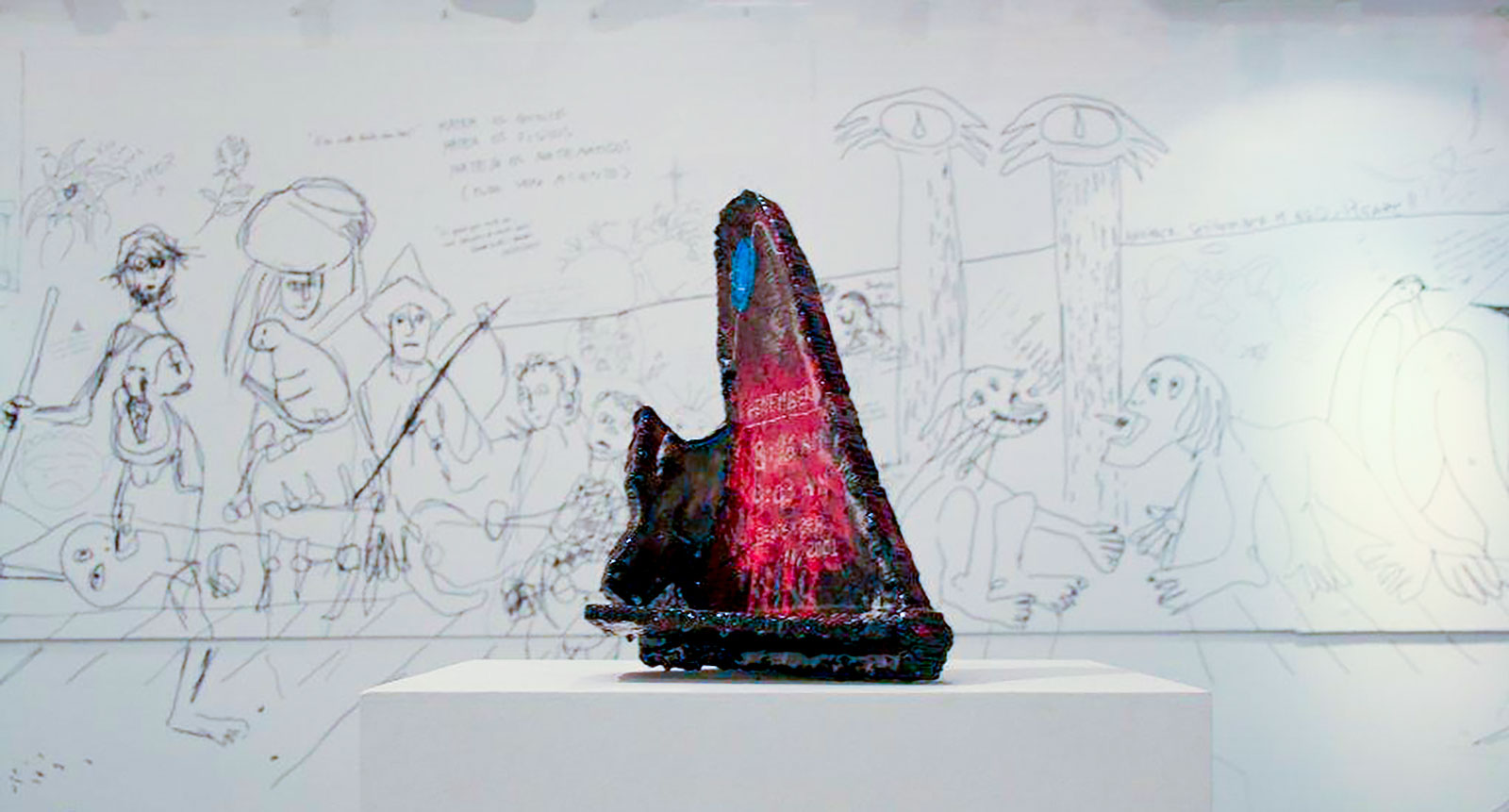
Penteado’s visual and literary clues evoke integration from fragmentation; death and resurrection; the emergence of beauty from the ashes. To accomplish these ends he has reinvented Picasso’s Guernica and extracted the doves of peace from the iconic flying severed head. A fragment of one of the steel girders from the towers has been resurfaced and repainted with life/death figures based on the severed head motif. They could be read alternately as ascending doves or falling leaves from the laurel crown of victory.
These horrible events and Duda Penteado’s call to resurrect beauty from the ashes remind me of a song sung by the striking North American coalminer’s during the late 1920’s and the 1930’s.
Which side are you on?
Which side are you on?
In Harlan County there are no neutrals
Which side are you on?
THERE IS A GLOBAL VILLAGE
where ancient grievances, endless
agonies turn on lathes
of uncountable echoes. There is
a plea never heard in the din of gain,
an infinite vowel careening
from a severed head suspended
between Guernica and Nankind
New York and Babi Yaar,
Wounded Knee and Santiago de Chile
tossed by the bull
of ancient grievances. We mourn
in the marrow of blue-violet ashes
where we would the bone dust
of fallen comrades turn to light
in the figure of an iris. Who
are the fallen? Is it Adam, his finger
still stuck to the finger of god
with primordial slime?
khadesha’s clavicle bent by the pestles
of rage in the crucible
of negotiations, vendetta and famine?
Whose memory survives this mausoleum
suspended beneath two pillars of smoke,
the archeological dust of Antioch,
a cave on Okinawa,
the 1000 - year stench of Kosovo?
If it is our will there shall be
more of these monuments.
G.N.P
(George N. Preston, Ph.D. — Art Critic / Professor
Emeritus of Art History, City College, CUNY ) 2002